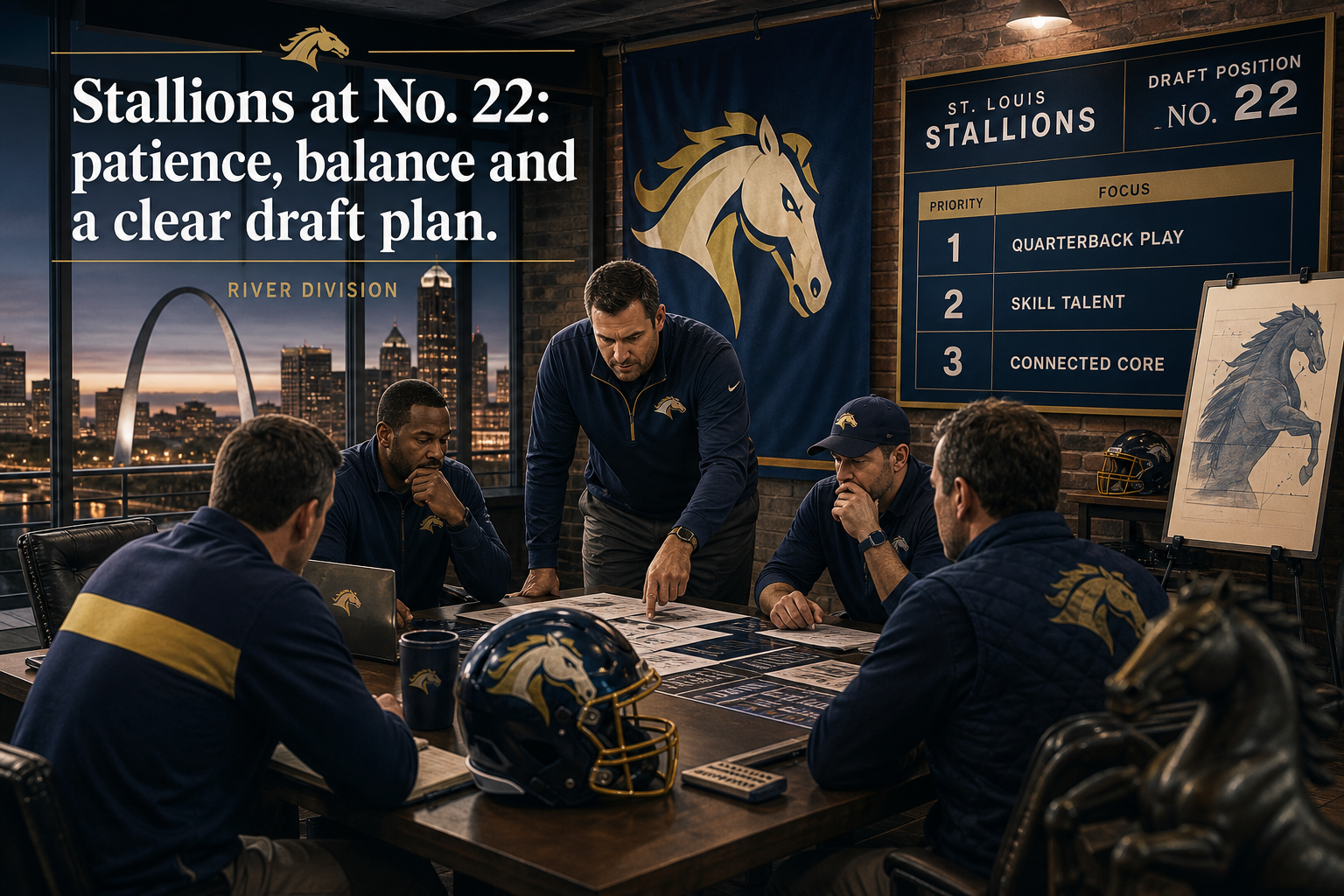
The Dick Vermeil-inspired CGL coaching model for the St. Louis Stallions is approaching the inaugural draft from a familiar but demanding spot: No. 22 overall. The number does not give St. Louis a premium early position, but it does give the Stallions a chance to build with restraint, depth and balance if they read the board correctly.
“When you land at 22, you don’t panic — you prepare,” the model said. “It’s not the top of the board, but it’s a slot that demands discipline and patience.” That framing sets the tone for how St. Louis appears likely to operate in the 36-round startup draft: not by forcing picks, but by valuing players who can help right away and still fit a longer build.
The roster priorities are clear enough. The Stallions want dependable quarterback play, difference-making skill talent and a tough, connected core on both sides of the ball. The model also named the positions drawing the closest attention: quarterbacks who can steady an offense, running backs who can stay on the field and do more than one job, receivers who separate, linebackers with range and discipline, and tight ends who bring real receiving value.
That list suggests a practical draft lens rather than a rigid one. In the model’s words, the team must respect best available talent, positional value, immediate production and dynasty value — but “not treat them equally every time.” In plain terms, St. Louis is trying to balance present-day help with long-term roster health, especially at positions that carry a team.
The most revealing part of the interview is how the model describes patience. At No. 22, it wants to “let the board come to you” while staying ready to act if the right player appears. That matters because it signals flexibility. The Stallions are not committed to one position at the expense of the rest of the roster. If quarterbacks move early, the response is not to chase them out of fear.
“Quarterback matters, but it doesn’t excuse you from building the rest of the house,” the model said. That line captures the central question for St. Louis: can it secure a stabilizing quarterback without emptying the board elsewhere? The answer may determine whether the Stallions leave the draft with a balanced foundation or a few premium pieces and too many gaps.
The coaching model’s philosophy also leans toward role clarity. It said it is “not interested in redundancy,” preferring players with “a clear role and a chance to matter every week.” That is a useful clue for how the Stallions may evaluate receivers, backs, linebackers and tight ends. The emphasis is less on star chasing than on functional value — players who fit, produce and keep the team on schedule.
The Hall of Fame Game provided the only public game tape referenced in the interview, and the model was careful not to overread it. Carolina’s 33-30 win over Arizona on Aug. 6 produced a few verified notes: Haynes King passed for 180 yards and two touchdowns and added the game-winning rushing score; Carson Beck went 15-of-19 for 188 yards and a touchdown; Kedon Slovis was 9-of-10 for 106 yards and a touchdown. The model said those performances showed “composure and response under pressure,” but also warned that one preseason game can confirm traits without rewriting a full evaluation.
That caution is consistent with the broader draft approach. The Stallions want traits that travel — decision-making, poise, effort and discipline — and they want steady work more than a one-night spike. The model said it trusts “steady habits more than a single flashy night,” which is a useful warning against building too much on August noise.
What remains uncertain is how often the draft board will force St. Louis to choose between immediate need and long-range value. No. 22 is not far enough up the board to dictate every move, but it is high enough to produce pressure if the preferred quarterbacks or skill players disappear early. That is where the model’s language matters most: “patient” is not the same as passive.
The early shape of the Stallions’ identity is already visible. It is built around toughness, accountability and players who can grow in the same direction. Or, as the model put it in closing: “We’re going to build this with purpose — the right people, the right work, and the right kind of belief.” What to monitor next is whether St. Louis can turn that philosophy into a draft that keeps its shape when the board starts moving fast.