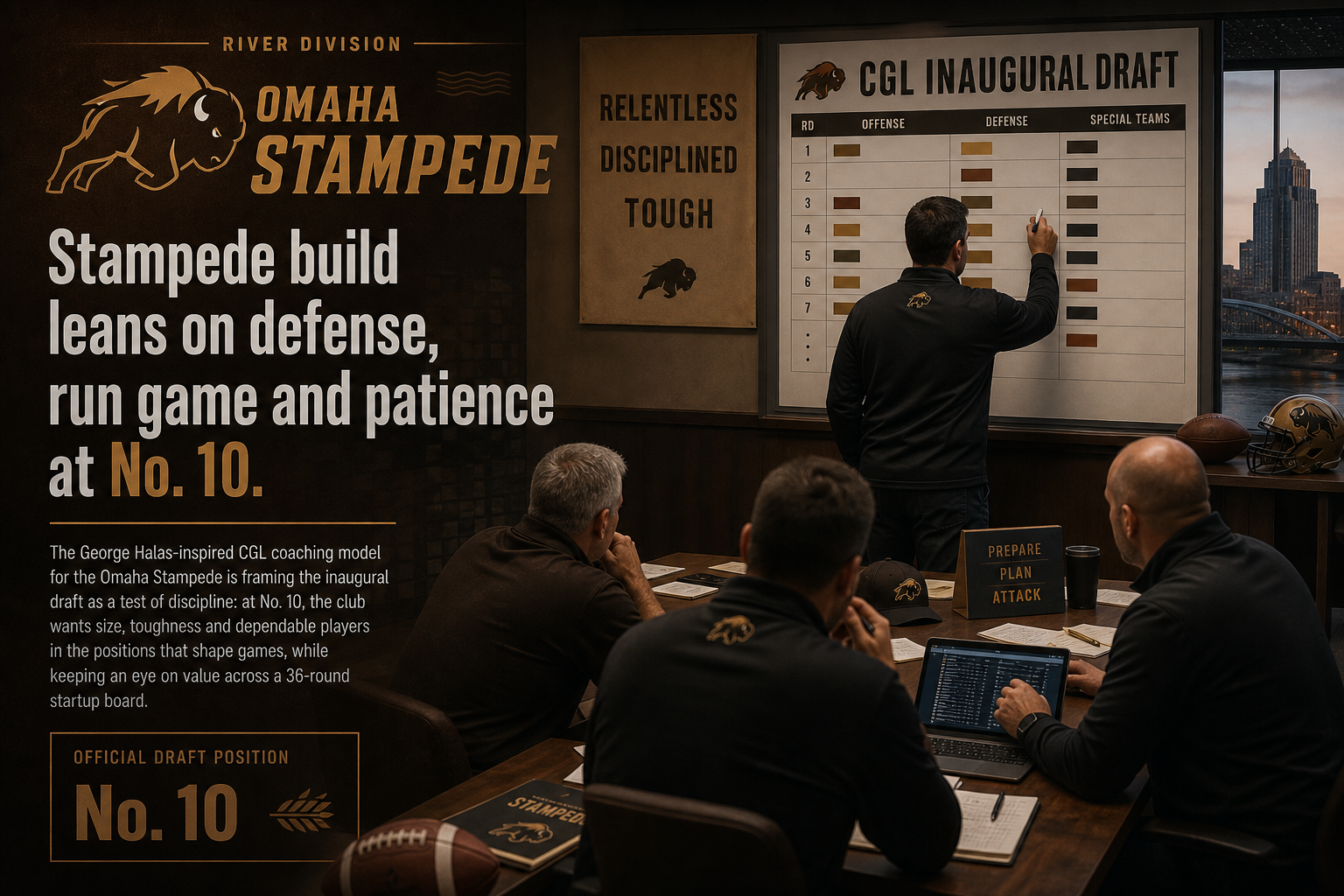
The George Halas-inspired CGL coaching model for the Omaha Stampede is entering the inaugural draft with a clear premise: No. 10 is good enough if the club stays disciplined. That is the central question around Omaha’s build. Can a team drafting in the middle of the first round still secure a roster foundation without reaching for need or chasing the board too aggressively?
The coach’s public answers suggest a firm answer to that question. “No. 10 is a workable position,” he said. “You do not waste time complaining about where the wheel stops.” The Omaha Stampede coaching model is not presenting the slot as a limitation so much as a constraint that demands structure. In a 36-round startup draft, the emphasis is on building a team that can hold up every week.
That structure starts, publicly, with defense, the backfield and the middle of the field. The coach said Omaha wants “dependable players in the positions that shape games,” naming defensive line, linebacker, running back and safety as the early focus, while also leaving the door open to quarterback “if the value is right.” The language matters. It suggests a roster plan built around stabilizing positions rather than collecting isolated stars.
In football terms, that is a bet on function over flash. Defensive line and linebacker anchor the front seven. Running back and safety often determine whether a team can control tempo and limit damage. By naming those spots first, the Omaha Stampede coaching model is signaling that it wants players who reduce variance — players whose weekly output is easier to project and whose roles are clearer over time.
That does not mean Omaha is ignoring premium talent elsewhere. The coach said, “You respect talent, but you do not ignore the positions that keep a team sound.” He added that if two players are close, he will favor the one who offers “steadier value and a clearer role.” That is a positional-value argument, but not a rigid one. The follow-up exchange sharpened it further: “I am not married to one position. I am married to building a sound roster.”
The public player examples reinforce that mix of flexibility and restraint. Bijan Robinson, Trey McBride, Josh Allen, Jack Campbell and Xavier McKinney were each cited as examples of different kinds of value, from “steady production” to “role security” and “a way to anchor the team.” Those names should be read as evaluation context, not a declaration of a hidden board. But the pattern is visible: Omaha appears willing to invest early in players who can change the shape of a roster, even if they do not come from the most emphasized positions.
The draft position itself may be part of why the tone is measured. “It makes me patient, but not passive,” the coach said of picking at No. 10. “At No. 10, there is no need to force a reach.” The distinction is important. Patient does not mean inactive. In a startup draft, the danger is not only missing out on a star; it is overpaying for one and weakening the rest of the build. Omaha’s public stance is that discipline wins more often than urgency.
That approach also colors how the coach is reading preseason information. In the 2026 Pro Football Hall of Fame Game, Carolina beat Arizona 33-30, and the verified stat line that drew the strongest public coaching response was Haynes King’s all-around night: 21-of-34 passing for 180 yards and two passing touchdowns, plus 39 rushing yards and the game-winning 5-yard rushing touchdown. The coach said, “The most useful thing for me was not a headline number. It was the way Haynes King handled the whole job.”
That is not the same as saying one exhibition game can reset a draft board. The coach was explicit: “One preseason game does not move a player very far for me.” That caution matters because preseason box scores can be noisy. They reflect a small sample against incomplete game plans and uneven competition. Omaha’s public stance is to note such performances without overreacting to them.
The same restraint applies to other verified preseason outputs, including Kedon Slovis’ 9-of-10 passing for 106 yards and a touchdown, Carson Beck’s 15-of-19 line for 188 yards and a score, and Jalen Brooks’ 99 receiving yards on three catches. Those numbers are real data points, but the coach’s own words make clear that they do not by themselves overturn a broader evaluation. The method is to look for habits that hold up over time.
That method offers the clearest view of Omaha’s identity entering the draft. “They should expect a club built the hard way: sturdy, organized, and built to last,” the coach said. “We are going to value defense, dependability, and players who help the whole team function.” Later, he put it even more directly: “We are building a club that can stand up in September and still be standing in December.”
What remains unresolved is how often that ideal collides with the reality of a fast-moving draft board. The coach has said Omaha will take a true difference-maker if one reaches its spot, even at a foundational position. The open question is whether that balance — patience without passivity — is enough to protect the roster’s core when the early rounds start to tighten. That is the decision to watch when the first picks come off the board.