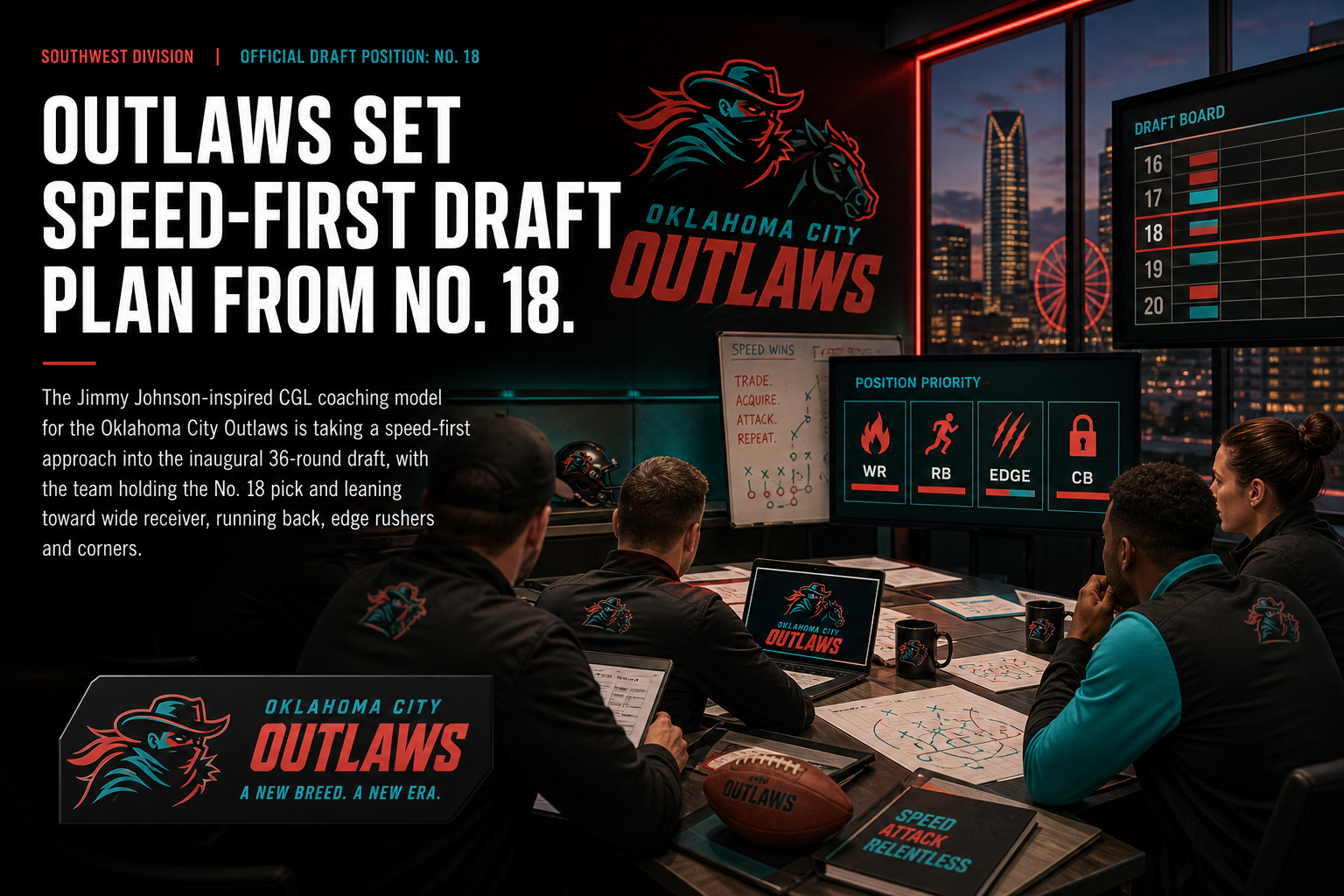
The Jimmy Johnson-inspired CGL coaching model for the Oklahoma City Outlaws is entering the inaugural draft at No. 18 with a clear preference for speed, playmakers and young players who can grow with the roster. The Outlaws’ approach, as described in a public pre-draft interview, centers on explosive positions and long-term value rather than forcing a pick to fit a label.
“Eighteen gives us work to do, and that’s fine,” the coach said. “You don’t win a startup by staring at the board wishing you were five spots higher. You win it by knowing where the value is and staying ready to move when it comes to you.”
The Oklahoma City Outlaws coaching model said the club wants “speed, playmakers, and young players who can grow with us,” with the backbone starting at “wide receiver, running back, pass rush, and coverage.” The coach later narrowed that emphasis to wide receiver, running back, edge rushers and corners, while leaving room to consider quarterback or tight end if the value is strong enough.
“That means if the right receiver or back is there, I’ll take him,” the coach said. “If not, I can pivot to edge or corner and still keep the roster fast and competitive.”
The draft slot, and the coach’s response to it, appear to shape a plan built on discipline and flexibility. Rather than treating No. 18 as a limitation, the Outlaws view it as a prompt to identify tiers, stay patient when needed and move quickly when a target separates from the group.
“Best talent matters, but so does where that talent plays and how long it stays valuable,” the coach said. “I’m not chasing short-term points at the expense of the roster’s future.”
That balance showed up again when the coach discussed how the Outlaws will handle positional value. The stated goal is not simply to add the most recognizable names, but to leave the first half of the 36-round startup draft with a foundation that can hold up over time.
“I want players who help now and don’t age out on us before the rest of the league notices,” the coach said.
The interview also offered a measured read on the 2026 Pro Football Hall of Fame Game, won by Carolina 33-30 over Arizona on Aug. 6. The coach pointed to quarterback control and competitive poise, citing Haynes King’s dual-threat finish and Carson Beck’s efficiency, while making clear that one exhibition game will not alter the larger board.
“The thing that stood out most to me was quarterback control and competitive poise,” the coach said. “Haynes King made plays with his arm and his legs, and that kind of dual-threat finish can move a player’s value if it keeps showing up. Carson Beck was efficient, too. But one preseason game doesn’t move a player into a different class for me by itself.”
That stance leaves the Outlaws’ priorities intact. Quarterback and tight end are not being ignored, but they are not driving the early plan. The primary focus remains on explosive players at receiver, running back, edge and corner, all viewed through the lens of age, role growth and future value.
“It makes me aggressive in a smart way,” the coach said of the No. 18 pick. “I’m not waiting around for the board to come to me if a tier is there and worth taking.”
For Oklahoma City, the larger target is a roster that can improve quickly without becoming old before it matures. The coach said fans should expect a team that gets “faster, younger, and more dangerous” as the draft unfolds.
“We’re building a fast, young roster that can win now and keep getting better,” the coach said. “That’s the kind of team I want the Hideout to see.”
The Outlaws will enter the opening rounds of the inaugural 36-round draft in the Southwest Division with the 18th overall position. Their next confirmed step is the draft itself, where the stated emphasis on explosive positions will be tested against the board.