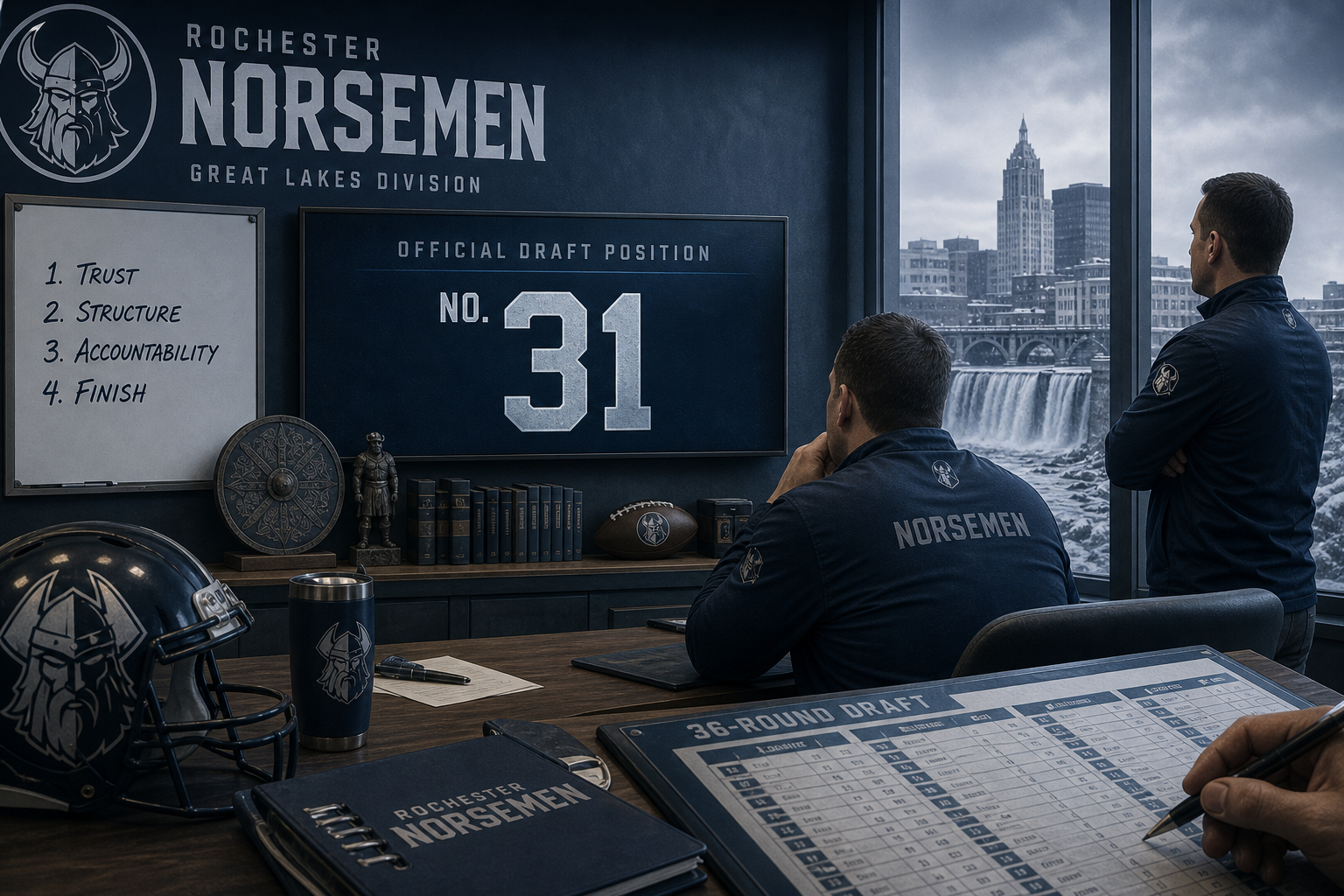
The Tom Coughlin-inspired CGL coaching model for the Rochester Norsemen is making its first public case for how it wants to build the franchise: patiently, around dependable players, and with an eye on roles that carry real weekly value. That approach matters because the Norsemen hold the No. 31 pick in the inaugural draft, a late-first-round position that forces harder tradeoffs than a top-five slot would.
The coach did not frame that draft spot as a problem so much as a test of discipline. “It’s late in the first round, so you have to be honest about it,” he said. “You don’t get the cleanest choice, but you still get a quality player if you stay disciplined and don’t reach.” The message was consistent throughout the interview: let the board come to you, avoid forcing a pick, and value players who can be trusted.
That philosophy points to a roster plan centered on quarterback, running back and receiver, with linebacker and safety close behind. The model also said it respects tight end when the position offers “real weekly value.” In plain football terms, the emphasis is on positions that can touch the ball or anchor the middle of the field, then on defenders who must make the defense function every week.
The larger roster idea is not just talent accumulation. It is structure. “I want a roster built on dependable players who show up every week and handle responsibility,” he said. “The foundation starts with quarterback, running back, and receiver, then we keep adding tough, assignment-sound players on both sides. No shortcuts. We need a team that can be trusted.”
That language suggests a startup draft board built less around splash and more around reliability. The coach said best available talent still matters, but not if it distorts the roster. He wants players who can help now, retain value over time, and fit roles that matter. If options are close, he said he leans toward “reliability and role security.”
The No. 31 slot appears to sharpen that preference. In follow-up comments, he drew a line between patience and selective aggression: “You press only when the player is a clear tier above what you expect to see back.” Otherwise, he said, the team should wait. That is a classic late-first-round calculation, especially in a 36-round startup draft where early mistakes can echo for a long time.
The coach’s standards for trust are equally clear. Assignment discipline comes first, followed by durability and communication. “If a player knows his job and does it the same way every week, you can build around him,” he said. That matters on offense, where he wants defined jobs, and on defense, where communication and consistency prevent repeated breakdowns.
The only outside football evidence he discussed was the Aug. 6 Hall of Fame Game, a Carolina-Arizona preseason game he used as a limited reference point rather than a board changer. Carolina beat Arizona 33-30. Haynes King completed 21 of 34 passes for 180 yards and two touchdowns, added 39 rushing yards and scored the game-winning 5-yard rushing touchdown. Jalen Brooks had three catches for 99 yards. Kedon Slovis went 9 of 10 for 106 yards and one touchdown. Carson Beck went 15 of 19 for 188 yards and a touchdown. AJ Dillon scored on a 1-yard run.
The coach said the quarterbacks “handled the moment well,” but added that he was not moving major opinions off one preseason game. King’s dual-threat production and Brooks’ route finishing and yards after the catch were noted as traits that fit the model’s preferred roles, but only as one data point. “One game is one game,” he said. “It doesn’t move a player into a different class by itself.”
That caution is important. The preseason context can inform evaluation, but the interview does not show a board reset. The safer reading is that the Norsemen view single-game output as confirmation only if it repeats against different looks and under rising game speed. For a quarterback, he said he wants poise, ball security and decision-making when the picture changes. For a receiver, he wants separation and finishing that hold up when the game speeds up.
So what should the Norsemen’s opening draft tell us? The answer is that the team wants order before upside. It wants a roster that can win in September and still hold up in December. It wants players who understand their assignment and can be trusted not to force the staff into constant repairs.
“We’re going to build this team the right way — with discipline, consistency, and players you can trust,” the coach said. That is the standard the Rochester Norsemen are setting before the first pick is made, and it is likely to shape every decision once the board starts to move.